[ Consumer Attitudes ]

An attitude is a tendency to respond positively or negatively towards a certain idea, person, object or situation (Solomon et al. 2019). Attitudes can be formed in a myriad of different ways, where it is evident that the attitudes placed on Panadol is formed through instrumental conditioning. This means the consumption of the attitude object is negatively reinforced, as Panadol is aimed to relieve pain. Overtime, this reinforced attitude and behaviour is learnt, allowing for Panadol to continue being a preferred and favourable pain relief medication purchased by many Australians. This is translated in Panadol’s market share of 28%, which is closely followed by Nurofen at 22%, with the only difference being the main active ingredient (Choice.com, 2014). Further, Panadol holds a utilitarian function, as consumers’ attitudes on this brand is clearly based around the amount of pleasure (pain relief) and satisfaction it offers.

~

On the other hand, attitude change occurs when an attitude is modified. This means change can occur when a person shifts from positive to negative, slightly positive to extremely positive or from having no attitude to having one (Petty, Wheeler & Tormala 2003). Panadol’s brand campaign ‘Home of Reconnection’ (seen below) encapsulates attitude change by encouraging everyday Australians to switch off technology, increase wellbeing and reconnect with their family and friends.

This is because research has highlighted the increase of Australians suffering tension and stress headaches are due to the overuse of technology (Green, 2017). Panadol recognises that the nature of headaches have changed, and therefore the way we deal with them must change as well (Green, 2017). This strengthens our favourable attitudes towards Panadol as the brand helps establish the need to have digital detoxes in order to naturally reduce tensions and headaches. This campaign broadens our perspective from immediate pain relief to ‘switching off life headaches’, which embraces Panadol’s brand image of “When pain is gone, life takes its place.” By using effective promotion, Panadol emphasises an attitude change in switching off technology and reconnecting with loved ones in order to increase overall wellbeing, which reflects their strong brand image of life taking place when pain is gone (Long, 2017).  

Furthermore, the campaign was interactive in nature as they promoted the chance to win a free stay at the Home of Reconnection, which pushes consumers into an increasingly favourable attitude towards Panadol. This is because it shows the brand is interacting with their consumers in reflection of their image, assisting in strengthening attitude change towards technology and reconnecting with loved ones (Long, 2017).

~

Choice.com, 2014, Pain Relief Drugs: Panadol and Nurofen, viewed 10/05/2019, https://www.choice.com.au/health-and-body/medicines-and-supplements/prescription-medicines/articles/pain-relief-drugs-panadol-and-nurofen

Green, R. 2017, Panadol puts its brand purpose into action with ‘Home of Reconnection’ Launch via Whitegrey, viewed 10/05/2019, https://campaignbrief.com/panadol-puts-its-brand-purpose/

Long, D. 2017, Panadol urges people to switch off technology headaches in new campaign, viewed 10/05/2019, https://www.thedrum.com/news/2017/11/01/panadol-urges-people-switch-technology-headaches-new-campaign

Petty, R. E., Wheeler, S. C., & Tormala, Z. L. (2003). Persuasion and attitude change. In T. Millon & M. Lerner, Handbook of psychology: Personality and social psychology (pp. 353-382). Hoboken, NJ: Wiley.

Solomon, M., Russell-Bennett, R. and Previte, J. (2019) Consumer Behaviour, Australian Edition, 4th Ed., Pearson, p. 250-268.

[ Motivation & Values ]

Motivation is the driving force within individuals that compels them to behave as they do (Solomon et al. 2019). This driving force is produced by a state of uncomfortable tension, which drives consumers to reduce or eliminate this feeling by attempting to satisfy their needs. As a result, this will bring about a more comfortable state. Consumers are motivated to satisfy their utilitarian needs. Utilitarian motivation i.e. a desire to achieve some functional or practical benefit epitomises the ideals of Panadol, as this brand is a pain-relief medication. As pain relief medication is a necessary and innate need to sustain physical life, it is important for Panadol to market their products in a way that motivates consumers to purchase from them. This is in relation to other generic paracetamol brands that sell the same active ingredient for a much cheaper price.

~

So how does Panadol successfully motivate consumers to purchase their products?

~

Panadol has been successful in creating products that provide the desired benefit of pain relief which in turn permit the consumer to reduce the tension to achieve competitive differentiation. This brand significantly outsells cheaper generics (ABC Health and Wellbeing, 2015), by continually motivating consumers to purchase from Australia’s most trusted pain reliever. In my opinion, Panadol’s effective positioning of their brand has lead consumers to forgetting the active ingredient of paracetomol, to calling this medication as Panadol as a whole. This results in a strong built up brand image, which prompts consumers to continually re-purchase and support.

In reference to this Panadol Australia ad, using celebrity endorsement of Australian TV presenter Joh Griggs helps catch the attention of consumers. This application allows for a more favourable view of the brand itself as delving into an innate need to relieve pain with the use of a well-known celebrity means individuals will feel more motivated to at least give Panadol a go. Being a utilitarian need with a rational motive means consumers are more inclined to purchase Panadol as it is important to relieve physical pain to continue to live life.

In addition, Maslow’s hierarchy of needs displays medicine as a core psychological need (Solomon et al. 2019). By positioning Panadol as “Australia’s most trusted pain relief”, consumers will opt for this brand as it is an important need in sustaining human life. By relieving pain and satisfying this basic need of maintaining life, consumers are able to go on about their day in order to satisfy higher, more complex needs.

~

ABC Health & Wellbeing 2015, Paracetamol: targeting pain, generic brands and other things you need to know, viewed 6th May, https://www.abc.net.au/health/features/stories/2015/02/23/4181731.htm

Solomon, Michael., Russell-Bennett, R. and Previte, J. (2019) Consumer Behaviour, Australian Edition, 4th Ed., Pearson, p. 172-178

[ The Self Concept ]

Who am I? This question points to a deeply engrained need within consumer behaviour in understanding the basis for the experience of consciousness known as the Self (Nour Foundation, 2010). The self and self-concept is a complex structure which encompasses our individual perceptions of our behaviour, abilities and unique characteristics as well as how we evaluate our self based on these qualities (Solomon et al., 2019). Whether these attitudes are positive or negative, they will help guide many purchase decisions as certain products can boost our self esteem or be rewarding for the self.

~

Self esteem refers to an individual’s overall sense of self worth and self concept (Cherry, 2019). For example, those with low self esteem attempt to avoid embarrassment, failure and rejection at all costs and expect that they will not perform well on tasks (Solomon et al., 2019). Influencing self esteem through marketing can be seen through the exposure of models in ads which can trigger social comparison (Jun et al., 2017). This process may prompt consumers to evaluate their appearance rather negatively by comparing themselves to the models depicted in the artificial ads. By feeding into the insecurities of consumers through supplying idealised images of attractive people using specific products, marketers can strongly influence how consumers think and feel about their self concept (Solomon et al., 2019).

~

Panadol strives for positive self-concept and promotes high self esteem through the use of everyday individuals within their ads. By choosing models of all shapes and sizes from various cultural backgrounds, the focus shifts from physical appearance to what is actually being advertised- the need for pain relief medication in a variety of real life, relatable situations.

Panadol promotes the ability to live our best healthy lives by consuming this product when experiencing a headache or overall pain. This in turn aids positive self concept and higher self esteem for individuals in order to avoid the failure of performing poorly on everyday tasks due to pain. Further, the process of social comparison with Panadol will allow consumers to evaluate  the necessity of this pain relief medication in comparing themselves to those in the ad that are unstoppable because they are not experiencing anymore pain.

~

Cherry, K. 2019, What exactly is self-esteem, viewed 27/04/19, https://www.verywellmind.com/what-is-self-esteem-2795868

Jun, S, Jeong, Y, Gentry, JW & Hyun, YJ 2017, ‘The moderating effect of self-esteem on consumer responses to global positioning in advertising’, International Journal of Advertising, vol. 36, no. 2, pp. 272–292, viewed 27/04/19

Nour Foundation 2010, Perspectives on the Self, viewed 27/04/19, http://www.nourfoundation.com/events/Perspectives-on-the-Self/Conversations-on-Identity-and-Consciousness.html

Solomon, M., Russell-Bennett, R. and Previte, J. (2019) Consumer Behaviour, Australian Edition, 4th Ed., Pearson, p. 210-220

[ Learning ]

Learning is the ongoing process of acquiring knowledge that results in relatively stable changes in behaviour caused by experience (Solomon et al. 2019). According to behavioural learning theories, learning occurs through external observable behaviour rather than considering the internal mental state (Solomon et al. 2019).

~

Panadol, a world leading paracetomol-based pain relief has applied the principle of stimulus generalization, evidently providing greater opportunities for consumers to learn and remember their brand. Stimulus generalization refers to the tendency to evoke similar positive conditioned responses, which is strengthened through product line extension by Panadol’s expansion of Panadol Rapid, Panadol Extra, Panadol Osteo, Children’s Panadol range, Panadol Optizorb… just to name a few.

Product Line Extension

By extending their brand name to multiple items within the same product category, Panadol enlarges their product portfolio and as a result, provide consumers with greater variety and meet the needs of refined target markets. Overall, product line extension aids brand equity of Panadol as the brand continues to prompt strong positive associations in the mind of consumers by giving them greater choice to match their needs to the certain range of the product category. In addition, this brand generalization strategy increases the chances that consumers will respond positively to the added items in the same way that they respond to the original Panadol item.

~

Panadol has also successfully displayed operant conditioning in the form of negative reinforcement within this product. Their slogan “When pain is gone, life takes its place” highlights that something uncomfortable and unpleasant (pain) can be taken away in response to a stimulus (Panadol). Overtime, this reinforces their behaviour of taking Panadol in the future as it is expected that the unpleasant pain will diminish and thus negatively reinforcing the product.

~

Solomon, Michael., Russell-Bennett, R. and Previte, J. (2019) Consumer Behaviour, Australian Edition, 4th Ed., Pearson, p. 106-115

[ The Perception Process ]

When pain strikes, the general consensus for myself and I’m sure many others, is to ‘just take some Panadol’. Despite being a brand and not the actual medication itself, Panadol has clearly been successful in marketing its products to the point where it is preferred over cheaper generic equivalents (ABC Health and Wellbeing, 2015). This is regardless of the fact that these brands contain the exact same ingredients and have the exact same effects for pain relief (Choice, 2014).

So why do we generally opt for Panadol if there are cheaper equivalents?

Simple, we perceive Panadol as a trusted and reputable pain relief brand through the perception process of:

  • Exposure
  • Attention
  • Interpretation

~

Exposure occurs when a consumer’s senses are stimulated during the marketing campaign and can choose whether they want to be exposed to the ad (Solomon et al, 2019). Panadol’s varying sound level within television commercials and beneficial product claims help constitute exposure (Fraser & Bradford, 2013). Watch this to help you understand what I mean:

~

Image result for panadol ad

~

Secondly, attention refers to the extent to which processing activity is devoted to a particular stimulus (Solomon et al. 2019). Panadol captures our attention by stimulus selection factors such as size and colour. When flicking through a magazine, Panadol ads are one full page, which helps to grab our attention for approximately 2 seconds (Solomon et al. 2019). In addition, video advertisements (as seen above) are usually 30 seconds long in an attempt effectively inform consumers about the pain relief medicine before they lose focus (Solomon et al. 2019). The continuity of Panadol’s main colours being green, red and white also assist in maintaining the brand’s identity and thus our perception on the overall brand. The dominating use of green creates a sense of calmness and has strong symbolic ties to ‘safety’, which I believe would help boost confidence in taking this pain relief medicine (Solomon et al. 2019; Wiedmann et al., 2019). The use of red for the word itself on a white background emphasises the strength and effectiveness that Panadol can offer to everyday consumers (Solomon et al. 2019; Wiedmann et al., 2019).

Lastly, interpretation is the decoding of marketing messages (Solomon et al. 2019). Panadol’s approach to sell a benefit encapsulates the fact that consumers don’t care about the scientific ingredient, but rather they focus on its ability to help eliminate pain. Panadol’s market share of 28% (Choice, 2014) has been steadily increasing by allowing consumers to comprehend their slogan “when pain is gone, life takes its place”.

~

Panadol has powerfully marketed themselves as the best pain relief over many decades, by selling the benefit (pain relief) rather than the feature (paracetamol). It is evident that Panadol as a whole has been well perceived by everyday consumers as we continue to purchase their products over cheaper, generic brands like Panamax.

Do you perceive Panadol this way? Let me know in the comments!

~

ABC Health & Wellbeing 2015, Paracetamol: targeting pain, generic brands and other things you need to know, viewed 31/04/2019, https://www.abc.net.au/health/features/stories/2015/02/23/4181731.htm

Choice.com.au, 2014, Pain relief drugs: Panadol and Nurofen, viewed 31/04/19, https://www.choice.com.au/health-and-body/medicines-and-supplements/prescription-medicines/articles/pain-relief-drugs-panadol-and-nurofen

Fraser, C & Bradford, JA 2013, ‘Music to Your Brain: Background Music Changes Are Processed First, Reducing Ad Message Recall’, Psychology & Marketing, vol. 30, no. 1, pp. 62–75, viewed 30/04/19

Solomon, M., Russell-Bennett, R. and Previte, J. (2019) Consumer Behaviour, Australian Edition, 4th Ed., Pearson, p. 85-98.

Wiedmann, K., Haase, J., Bettels, J & Reuschenbach, C. 2019, ‘It’s not all about function: investigating the effects of visual appeal on the evaluation of industrial products using the example of product color’, Journal of Product & Brand Management, no. 1, p. 15, viewed 31/04/19

[ New year, New me…? ]

For the longest time in my head, I had always wanted some kind of a smart watch. I never actually considered buying one of course ($$$), I simply appreciated the product from afar. Until the new year came through of course…. I mean, new year, new me right (excuses)? I decided to treat myself with the Fitbit Versa as a means to keep track of my  daily steps, heart rate, sleep AND obviously the time.

But this final decision did not come easy….

~

As consumers, we are constantly faced with the need to make decisions about products (Solomon et al. 2019 ). Although my recent purchase was not as dramatic as buying a car or a house, I’d like to consider my purchase of the Fitbit as high risk as a broke university student, evoking the mindset of extensive problem solving.

When the new year kicked in, I decided to finally stop appreciating the concept of a smart watch from afar and actually put my energy into something that may aid my everyday motivation to become a healthier person. This is the first stage in the consumer decision making process known as problem recognition (Solomon et al. 2019).

I sought out information via YouTube reviews as well as my friends’ opinions on their different kinds of smart watches to evaluate the pros and cons of each brand/model, consisting of the Apple Watch, Fitbit Versa and Fitbit Alta. This pre-purchase search resulted in increased product knowledge and ultimately, increased satisfaction with the purchase outcome as it was an expensive investment that I did not want to regret (Solomon et al. 2019).

~

After evaluating all choices available to me, I decided against the Apple Watch as 1. it exhausted my mental budget and 2. I didn’t require all the excessive functions it came with. This left me deciding between the Fitbit Versa and Fitbit Alta and ultimately, the bigger digital screen and greater function capability of the Fitbit Versa sold me. This stage is known as product choice, as I finally chose the model based on the price of $200, functioning and aesthetics. My post purchase outcome is positive as I continue to wear my Fitbit to track all the necessities in maintaining a healthier lifestyle.

~

Despite consumer hyper choice (Solomon et al. 2019), I believe the Fitbit Versa was definitely the right choice for me. It is safe to say ‘New year, New me’ is going well so far, but maybe get back to me in a few months time and ask me the same question (please don’t).

~

Solomon, Michael., Russell-Bennett, R. and Previte, J. (2019) Consumer Behaviour, Australian Edition, 4th Ed., Pearson, p. 286-319.

[ Social Marketing ]

As consumers, we’ve all viewed the influential commercials that encourage us to eat healthier or increase exercise as well as to discourage behaviours like texting and driving or driving fatigue.

How did they make you feel? Which campaigns compelled you to actually want to change your behaviour?

Personally, I think those campaigns directed at discouraging negative behaviour had more of an impact on my conscious thoughts and feelings than those encouraging positive behaviour.

~

This approach, known as social marketing, adopts commercial marketing techniques for the main purpose of positive behaviour change (Solomon et al. 2019). This is fundamental to address social problems like safety and wellbeing, public health or community development to benefit individuals and society as a whole (VicHealth 2016). Further, social marketing aims to deliver segmented social change programs that are effective and sustainable (International Social Marketing Association, 2017).

~

I believe driving fatigue commercials created by the NSW government discouraging this dangerous behaviour has been an effective social marketing campaign. The “Don’t Trust Your Tired Self” campaign informs consumers that driving fatigue is actually one of the top three contributors to the NSW road toll and is twice as likely to be fatal than other crashes (NSW Government, 2019). Additionally, the government has created an interactive test for consumers to take to see how tired they might be before driving.

As a consumer, this social marketing campaign is successful in its goal to prompt those at a greater risk of fatigue-related crashes to rethink their decisions and produce positive behaviour change.

~

International Social Marketing Association 2017, Social Marketing Definition, viewed 18/03/19, https://www.i-socialmarketing.org/social-marketing-definition

NSW Government 2019, Don’t Trust Your Tired Self, viewed 18/03/19, https://roadsafety.transport.nsw.gov.au/campaigns/donttrustyourtiredself.html

Solomon, M., Russell-Bennett, R. and Previte, J. 2019, Consumer Behaviour, Australian Edition, 4th Ed., Pearson

VicHealth 2016, The Changing Face of Social Marketing, viewed 18/03/19, https://www.vichealth.vic.gov.au/media-and-resources/blog/the-changing-face-of-social-marketing

[ Slacktivism ]

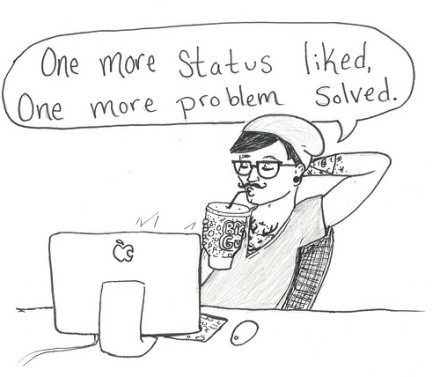
Slacking x Activism

~

The emergence of social media sites such as Facebook, Instagram and Twitter has allowed users to express concern about social and political issues rather effortlessly[1].

This can be done with minimal effort and commitment by nothing more than the click of a mouse through liking, sharing or tweeting about the issue at interest. This process gives rise to the contradicting term ‘Slacktivism’ (slacking whilst being an activist), which comprises of simple measures in support of the social or political issue[2].

So are we actually accomplishing anything more than self-satisfaction by sharing these posts?

A recent study suggest Slacktivism creates the underlying assumption that social and political assumptions can be fixed merely by interacting on social media as a substitute for protesting or volunteering in real life[3].  By passively liking or sharing a social justice campaign on Facebook, it hinders the propensity for us as users to actively engage in the situation. As we may all be aware of, 2014’s  #BringBackOurGirls campaign to save 200 Nigerian girls sent millions of social media users in a frenzy to share the hashtag, resulting in it trending globally on Twitter[4].

You’d assume this awareness would lead to progress in finding these girls, yet a year passed, the girls were still missing and the use of this hashtag no longer existed.

Therefore, it is clear that Slacktivism can result in very little real-life engagement by those supporting online.

 ~

In contrast, studies show Slacktivism has helped accomplish more than just individuals “doing their part”. The widespread Human Rights Campaign’s Facebook campaign that encouraged followers to change their profile picture in support of gay marriage helped the issue not only gain prominence but challenged societal power dynamics [5]. Further, the ALS Ice Bucket Challenge that circulated worldwide with even my closest friends participating actually lead to millions of dollars for ALS research[6].

Slacktivism influences consumer behaviour to participate in real world problems that interest us to create more awareness on social media. This is never a bad thing of course; the problem only occurs when there’s millions of shares and interaction on the organisation’s Facebook page yet not enough physical interest to reach financial targets or volunteers – all because we feel as though we’ve already done our part by interacting on social media.

~


[1] D.S Lane & S. Dal Cin, ‘Sharing beyond Slacktivism: The Effect of Socially Observable Prosocial Media Sharing on Subsequent Offline Helping Behaviour’ Information Communication and Society, vol 21, no.11, 2018, p. 1523-1540

[2] R Levya, ‘Exploring UK Millennials’ Social Media Consumption Patterns and Participation in Elections, Activism, and “Slacktivism”’, Social Science Computer Review, vol 35, no. 4, 2017, p. 462-479

[3] N Cabrera, C Matias & R Montoya, ‘Activism or Slacktvism? The Potential Pitfalls of Social Media in Contemporary Student Activism’, Journal of Diversity in Higher Education, Vol 10, no. 4, 2017, p. 400-415

[4] D Cook, B Waugh, M Abdunpanah, O Hashemi & S Rahman, ‘Twitter Deception and Influence: issues of identity, Slacktivism and puppetry’, Journal of Information Warfare, vol. 13, no. 1, 2014, p. 58-71

[5] S Vie, ‘In defense of “slacktivism”: The Human Rights Campaign Facebook logo as digital activism.’ First Monday, vol 19, no. 4, 2014, p. 159-163

[6] H Muslic, ‘What is Slacktivism and is it even helping?’ Nonprofit Hub, 20 June 2017, p. 2