Slacking x Activism
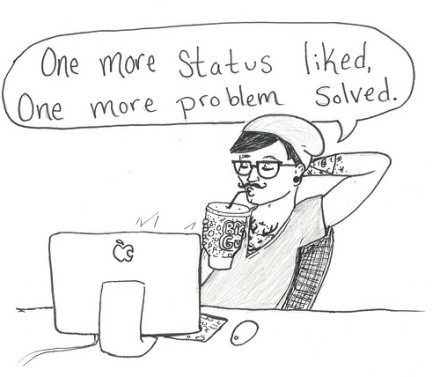
~
The emergence of social media sites such as Facebook, Instagram and Twitter has allowed users to express concern about social and political issues rather effortlessly[1].
This can be done with minimal effort and commitment by nothing more than the click of a mouse through liking, sharing or tweeting about the issue at interest. This process gives rise to the contradicting term ‘Slacktivism’ (slacking whilst being an activist), which comprises of simple measures in support of the social or political issue[2].
So are we actually accomplishing anything more than self-satisfaction by sharing these posts?
A recent study suggest Slacktivism creates the underlying assumption that social and political assumptions can be fixed merely by interacting on social media as a substitute for protesting or volunteering in real life[3]. By passively liking or sharing a social justice campaign on Facebook, it hinders the propensity for us as users to actively engage in the situation. As we may all be aware of, 2014’s #BringBackOurGirls campaign to save 200 Nigerian girls sent millions of social media users in a frenzy to share the hashtag, resulting in it trending globally on Twitter[4].
You’d assume this awareness would lead to progress in finding these girls, yet a year passed, the girls were still missing and the use of this hashtag no longer existed.
Therefore, it is clear that Slacktivism can result in very little real-life engagement by those supporting online.
~
In contrast, studies show Slacktivism has helped accomplish more than just individuals “doing their part”. The widespread Human Rights Campaign’s Facebook campaign that encouraged followers to change their profile picture in support of gay marriage helped the issue not only gain prominence but challenged societal power dynamics [5]. Further, the ALS Ice Bucket Challenge that circulated worldwide with even my closest friends participating actually lead to millions of dollars for ALS research[6].
Slacktivism influences consumer behaviour to participate in real world problems that interest us to create more awareness on social media. This is never a bad thing of course; the problem only occurs when there’s millions of shares and interaction on the organisation’s Facebook page yet not enough physical interest to reach financial targets or volunteers – all because we feel as though we’ve already done our part by interacting on social media.
~
[1] D.S Lane & S. Dal Cin, ‘Sharing beyond Slacktivism: The Effect of Socially Observable Prosocial Media Sharing on Subsequent Offline Helping Behaviour’ Information Communication and Society, vol 21, no.11, 2018, p. 1523-1540
[2] R Levya, ‘Exploring UK Millennials’ Social Media Consumption Patterns and Participation in Elections, Activism, and “Slacktivism”’, Social Science Computer Review, vol 35, no. 4, 2017, p. 462-479
[3] N Cabrera, C Matias & R Montoya, ‘Activism or Slacktvism? The Potential Pitfalls of Social Media in Contemporary Student Activism’, Journal of Diversity in Higher Education, Vol 10, no. 4, 2017, p. 400-415
[4] D Cook, B Waugh, M Abdunpanah, O Hashemi & S Rahman, ‘Twitter Deception and Influence: issues of identity, Slacktivism and puppetry’, Journal of Information Warfare, vol. 13, no. 1, 2014, p. 58-71
[5] S Vie, ‘In defense of “slacktivism”: The Human Rights Campaign Facebook logo as digital activism.’ First Monday, vol 19, no. 4, 2014, p. 159-163
[6] H Muslic, ‘What is Slacktivism and is it even helping?’ Nonprofit Hub, 20 June 2017, p. 2

 Consumer Behaviour
I’m guilty of slacktivism 🙂
LikeLike